

September 2014
Inside This Issue
I’m Partial to Partial Inductance!

 It is well known (but often forgotten) that the concept of inductance, without defining a complete loop of current, is completely meaningless! Some books give inductance of a length or wire, some people talk about the inductance of a via, and still others talk about the inductance of ground braids, etc. All these discussions about inductance ignore the requirement for a complete loop before the total or loop inductance can be discussed in any meaningful way.
The Silent Killer: Suspect/Counterfeit Items and Packaging

 Over the past several years, U.S. based organizations have curtailed traditional internal verification efforts due to reliance on contract manufacturers, distributors and suppliers to do the right thing. The inspection of ESD sensitive parts is very important, but without special safeguards, the additional handling to remove and repack a product for validation can cause both physical and ESD damage in the process. For parts, including those not sensitive to static electricity, measures must be utilized to detect, inspect and validate the packaging that identifies and protects the product.
ESD Influence on ICs

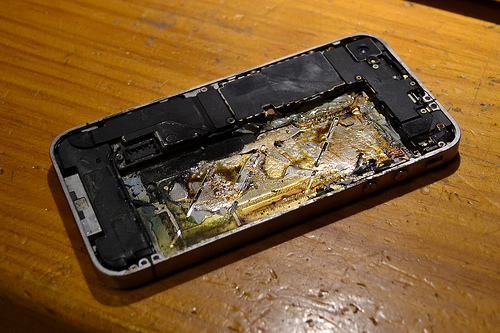 New developments in electronics manufacturing are increasingly dominated by the requirements of EMC today. Considerable follow-up costs in product development are caused due to the failure of electronic modules in EMC compliance tests. The integrated circuits that are used in an electronic system are critical for its EMC performance as a whole. ICs are often responsible for interference emissions or immunity weak points and it is difficult to gain control of them in such cases.
Fundamentals of Electrostatic Discharge – Part Five: Device Sensitivity and Testing

A Wreck of an Airplane
Characteristics of Air as an Insulator

How Fast Does a Charge Decay?

Featured in the Technical Library
Discover new products, review technical whitepapers, read the latest compliance news, and check out trending engineering news.
Get our email updates
